

The Circular Economy in Indian Manufacturing: Turning Industrial Waste Into Value
For decades, Indian manufacturing ran on a straight line: take raw material, make a product, throw away what's left. The circular economy rewrites that line into a loop — recovering waste and feeding it back into production. For Indian manufacturers, that shift is moving quickly from a sustainability talking point to a commercial necessity.
What is the circular economy?
The circular economy is an industrial model built on a simple idea: keep materials in use for as long as possible. Instead of the linear take‑make‑dispose path, a circular system designs out waste and keeps the value of materials circulating — through reuse, repair, remanufacturing and, critically, recycling.
The point isn't charity. It's that a tonne of material recovered is a tonne you don't have to buy, ship, or extract again — and a tonne that doesn't become a disposal cost or a landfill liability.
Why it's accelerating in India now
Three forces are pushing Indian factories toward circular thinking at the same time:
- Regulation. The E-Waste (Management) Rules, 2022, in force since 1 April 2023, run on Extended Producer Responsibility (EPR) — placing end-of-life handling squarely on producers and the downstream ecosystem. India generated an estimated 14.14 lakh tonnes of e-waste in FY 2025–26 (CPCB), and that is only one waste stream among many.
- Cost. Virgin raw materials and the energy to process them keep getting more expensive and more volatile. Recovered material decouples a manufacturer from some of that swing.
- Buyers. Large domestic customers and export markets increasingly ask for an ESG and circular-economy story — and want it backed by something real, not a slogan.
From linear to circular: what it looks like on the floor
A circular operation doesn't treat scrap, off-spec material and end-of-life product as garbage. It treats them as feedstock. The practical work is unglamorous: collecting waste reliably, sorting it by type and grade, and reprocessing it back to a quality the market will accept. Done well, the output isn't "recycled, therefore lower" — it's material that meets the same functional specification as virgin, at a better cost and a smaller footprint.
The mindset shift: a linear factory asks "how do we dispose of this?" A circular one asks "what is this worth, and how do we get it back into use?" The second question is where the margin and the compliance story both live.
A worked example: silicone
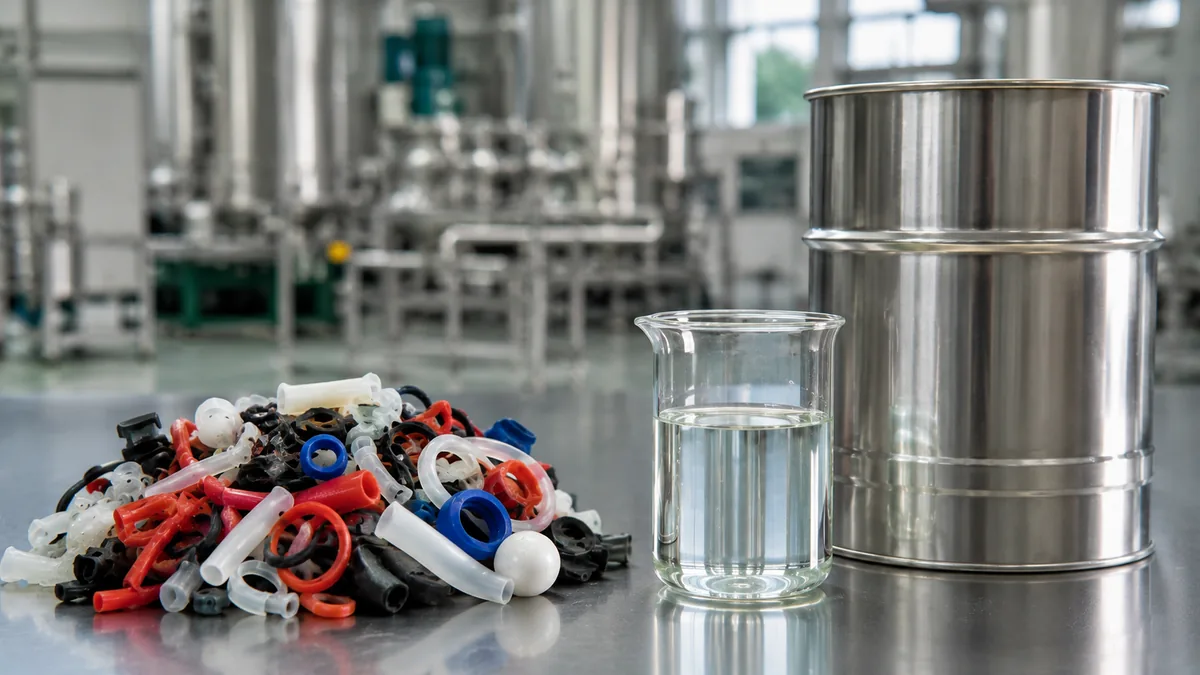
Silicone is a good illustration because it's so durable that disposal is genuinely wasteful — burning or burying it throws away a material that took energy and crude-oil-derived feedstock to make. At Ecovalley Silicones, cured silicone scrap, rubber, insulators and mould waste are collected and run through a controlled 7-stage process: high-temperature cracking breaks the cured polymer back into reactive precursors, which are filtered, distilled and re-polymerised into fresh, industrial-grade PDMS and DMC silicone oils — the same fluids the market would otherwise make from virgin feedstock.
Since 2016, that single loop has recycled 11,700+ tonnes of silicone and avoided an estimated 23,400+ tonnes of CO₂. One material, one company — multiplied across an industrial economy, that is what circularity adds up to.
The business case, in plain terms
- Lower input cost and less exposure to virgin-feedstock and import price swings.
- A compliance and EPR story you can actually evidence.
- Measurable ESG metrics — carbon and waste avoided — that buyers and boards increasingly require.
- Supply resilience from a shorter, domestic loop.
Frequently asked questions
What is the circular economy?
An industrial model that keeps materials in use for as long as possible — recovering, reprocessing and reusing them instead of following a linear take-make-dispose path. The goal is to design out waste and keep material value circulating.
Why is the circular economy important for Indian manufacturing?
Regulation (the E-Waste Rules 2022 and EPR), rising raw-material and energy costs, and ESG expectations from large and export buyers are all pushing manufacturers toward recovering and reusing materials rather than discarding them.
How does recycling fit into the circular economy?
Recycling is the practical mechanism that closes the loop: it recovers end-of-life or scrap material, reprocesses it to usable quality, and returns it to production — cutting dependence on virgin feedstock and keeping material out of landfill.
Building a circular supply chain?
If silicone is part of your waste stream — or your input — let's talk about closing that loop.
Get in touch