

Recycled vs Virgin Silicone: The Carbon Footprint Difference
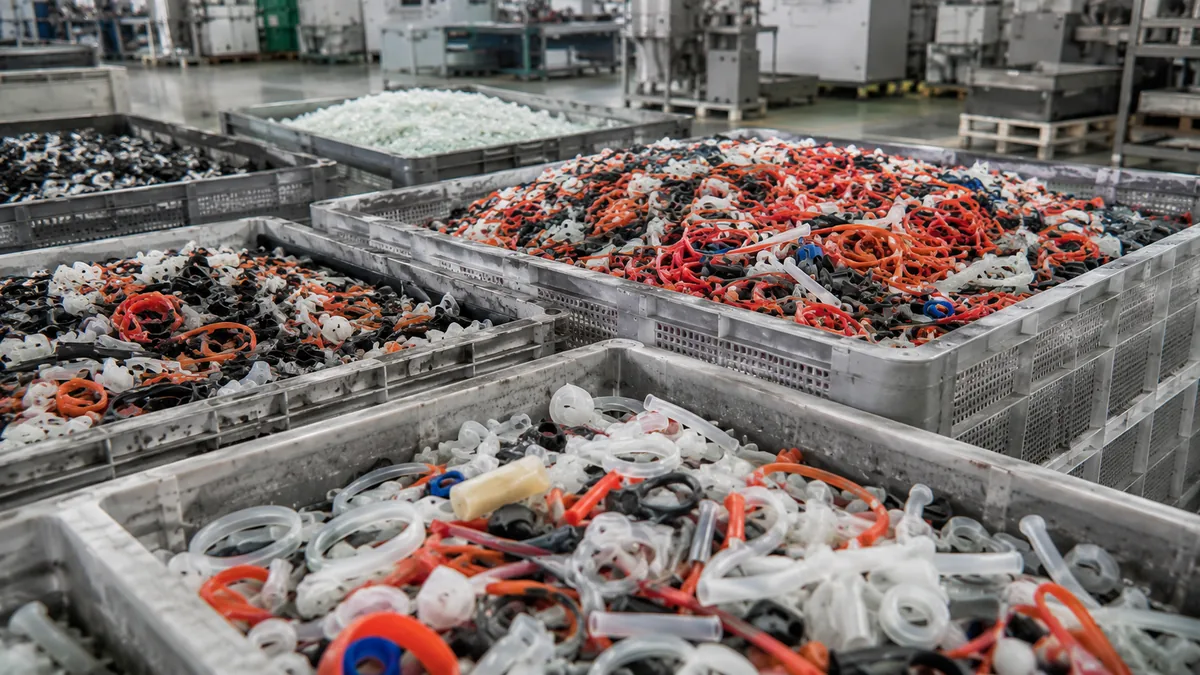
Silicone is brilliant in use and expensive to make — in energy and in carbon. Every tonne of virgin silicone carries the embodied emissions of its crude-oil-derived feedstock and the high-temperature processing that builds it. Recycled silicone recovers most of that value without re-running the full chain. For any company tracking its footprint, that gap is the number that matters.
Why virgin silicone is carbon-heavy before it's even used
Silicone doesn't come from nowhere. It's built from silica and crude-oil-derived inputs, processed at high temperatures through an energy-intensive chemical chain. Much of that energy is fossil-fuelled, so it's embodied in the material itself — carbon that's already "spent" by the time the silicone reaches a factory, before a single part is moulded.
That's the part most footprint conversations miss. The emissions of a silicone component aren't just what happens on your line — a large share is locked in upstream, in how the raw material was made.
What recycling actually saves
Recycling cured silicone back into usable oil doesn't re-run the virgin production chain. Through controlled depolymerisation, waste silicone is cracked, cleaned and rebuilt into industrial-grade PDMS and DMC — recovering the material that already exists instead of synthesising new molecules from feedstock. The result:
- Lower embodied carbon in the recovered material versus virgin.
- Energy recovered, not re-spent — the expensive part of making silicone isn't repeated.
- Feedstock kept out of the loop — less demand on crude-oil-derived inputs.
- Waste kept out of landfill and incineration — avoiding those end-of-life emissions too.
The headline number: to date Ecovalley has recycled 11,700+ tonnes of silicone and avoided an estimated 23,400+ tonnes of CO₂ — roughly two tonnes of CO₂ avoided for every tonne of silicone recovered instead of made new.
Why this lands directly in your Scope 3
For most manufacturers, the biggest slice of the carbon footprint isn't the factory's own energy (Scope 1 and 2) — it's Scope 3, the value-chain emissions, and purchased materials sit squarely inside it. That's the hard part of any reduction target, because it lives in your supply chain rather than on your own meter.
Switching part of your silicone supply from virgin to recycled lowers the embodied carbon of those purchased goods. That's a real, defensible Scope 3 reduction — not an offset, not a pledge — and it comes with the data to prove it: recovered tonnage and avoided emissions you can put in a report and stand behind. (For the reporting and regulatory side, see EPR, ESG and India's E-Waste Rules.)
The commercial read, not just the green one
None of this requires treating sustainability as charity. Recycled silicone is industrial-grade and batch-tested to the same functional specs as virgin, and its pricing is decoupled from virgin-feedstock and import volatility. So the lower-carbon choice is also, increasingly, the more stable and more reportable one. The carbon saving is the bonus that happens to be measurable.
For the fuller environmental case beyond carbon — energy, landfill, water and the circular-economy story — see the environmental benefits of recycling silicone.
Frequently asked questions
Does recycled silicone have a lower carbon footprint than virgin silicone?
Yes. Virgin silicone is made from crude-oil-derived feedstock through energy-intensive, high-temperature processing, so it carries significant embodied carbon. Recycling recovers cured silicone back into usable oil without re-running that full virgin chain, recovering most of the embodied energy and avoiding the associated emissions.
Why is virgin silicone carbon-intensive to produce?
Silicone starts from silica and crude-oil-derived inputs and is built up through energy-intensive, high-temperature chemical processing. That energy — much of it fossil-fuelled — is embodied in every tonne of virgin material, before any product is even made.
How does recycled silicone help Scope 3 reporting?
Purchased materials sit in a company's Scope 3 (value-chain) emissions. Switching part of your silicone supply from virgin to recycled lowers the embodied carbon of those purchased goods — a real, defensible Scope 3 reduction backed by recovered-tonnage and avoided-emissions data, not an offset.
How much CO2 does recycling silicone avoid?
It depends on volume and the virgin baseline, but the effect is material. Ecovalley has recycled over 11,700 tonnes of silicone and avoided an estimated 23,400+ tonnes of CO₂ — roughly two tonnes of CO₂ avoided for every tonne recovered instead of made new.
Lower the carbon in your silicone supply.
Whether you want recycled industrial-grade PDMS and DMC for your line, or a recovery route for your own silicone waste, we'll give you the specs — and the recovered-tonnage and avoided-emissions data for your reporting.
Talk to us